Herera
Industry
Women's Health
PROJECT TYPE
Collaborative UX Case Study
Timeline
8 months
Role
UX/UI Designer


Overview
Through our research, we identified a critical gap in the reproductive healthcare journey: women often lack the support and clarity they need between medical appointments. To address this opportunity, we designed Herera. A mobile health companion that helps users understand their symptoms, prepare for appointments, and make sense of their health data through personalized insights.
BACKGROUND
Herera was created as part of a capstone project in partnership with Red Thread Innovations. The challenge was to design a solution that empowered patients to navigate healthcare with confidence. Our team directed that challenge toward women's reproductive health.
The project came with clear guidelines: the solution had to be digital-first, grounded in real user needs, and ambitious without losing sight of practical usability. Every design decision had to trace back to the people we were designing for.

Understanding the gap
To understand why women struggle to get clarity and support for reproductive health concerns, our team conducted user interviews, surveys, and secondary research. What we found wasn't a lack of awareness, it was a system that wasn't built to support women between appointments.
The symptoms are real, and widespread…
90%
of women are affected by menstrual pain, with 10% experiencing pain severe enough to disrupt daily life
6-13%
of women have PCOS — yet ~70% remain undiagnosed
~10%
of women are affected by endometriosis, with diagnosis taking 4–12 years on average
The system isn't built to catch them
Three systemic issues compound the problem:
Women wait 30 minutes longer than men with comparable pain complaints, as reproductive pain is often normalized rather than investigated.
02 Fragmentation
Care is split across providers with no continuity, so cyclical symptom patterns — the kind that flag PCOS or endometriosis — go unseen.
Women have only been required in clinical studies for 33 years, yet make up 70% of chronic pain patients while most pain research still centers on men.
Existing tools track. They don't translate
We looked at the femtech landscape — Balance, Phendo, Flo, Stardust, Maven, Midi Health, Clue — and found a clear pattern. With over 1,000 femtech products on the market, most are built around logging: cycles, symptoms, fertility windows.

Defining the opportunity
The problem wasn't that women lacked information — it was that they lacked support in making sense of it
That gap shaped the question we designed around:
How might we design a digital tool that helps women of reproductive age better understand and manage their reproductive health symptoms throughout their healthcare journey so they feel confident, supported, and able to communicate their concerns to healthcare providers?
DESIGNING HERERA
Before sketching a single screen, we translated our findings into five design principles. These became the filter for every decision: what features to build, how information should be presented, and what kind of experience Herera needed to feel like.
01
Understanding before tracking
We designed Herera to explain what data means, not just collect it. Every feature should prioritizes explanation and context over collection.
02
Confidence in healthcare interactions
Herera equips women with the language, history, and tools to walk into appointments prepared.
03
Clarity and reassurance
Being dismissed is the core pain point. The app should acknowledge symptoms as real and legitimate — not just record them.
04
trustworthy health information
Women are already researching online. HerEra should be the source they can actually trust — clear, credible, and free of the noise.
The Experience, End to End
Rather than isolated tools, we built one continuous experience that travels with the user through every stage of the user's healthcare journey.
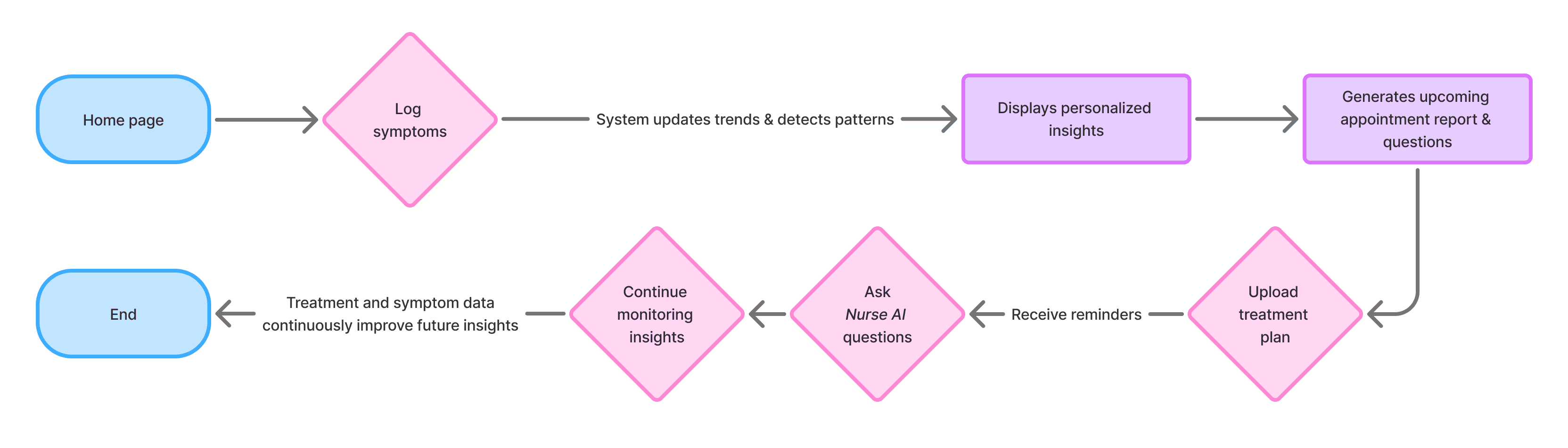
This flow reinforces our core value proposition:
Track
->
Understand
->
Prepare
->
Receive
->
Manage
->
Learn
Solution
Herera

Herera is a mobile reproductive health app that bridges the gap between medical appointments. Designed around the reproductive healthcare journey, it helps women better understand their health, navigate their care, and feel supported every step of the way.
Appointment Prep
By organizing symptoms, generating personalized questions, and summarizing health information, it helps users communicate their concerns more effectively and feel prepared for every appointment.

Post-Appointment Support
Helps users understand and follow through with their care after appointments by capturing appointment notes and providing AI-assisted clarification, it reinforces next steps and ensures users leave with greater clarity and confidence.
Nurse AI
Provides users with accessible, reliable support between appointments by helping answer health questions, explain information, and guide users toward their next steps.


Treatment Plan
Helps users stay connected to their care by organizing treatment plans, tracking progress, and providing reminders to support long-term health management.
The Treatment Plan simplifies care management into three steps: add treatments, set reminders, and track progress. By connecting symptoms with treatment data, users can better understand patterns and manage their care.

Scan

Verify

Follow through
Tracking
The Tracking feature lets users log symptoms and daily factors like mood, sleep, stress, lifestyle, and treatments. This helps them identify patterns and better understand their bodies over time.


Insights
The Insights feature turns tracked data into personalized patterns and simple, actionable guidance to help users make informed decisions about their care.
The IMPACT


REFLECTION
Reproductive health affects half the population, yet remains one of the most overlooked areas in both medicine and design. Working on Herera made that gap feel real. These weren't rare conditions, they were everyday experiences that millions of women navigate largely alone.
If I were to revisit this project, I'd push for earlier and broader user testing. Our research was strong, but there's a depth of lived experience we only scratched the surface of. More than anything, Herera reinforced that the most important design decisions happen before you open Figma.

